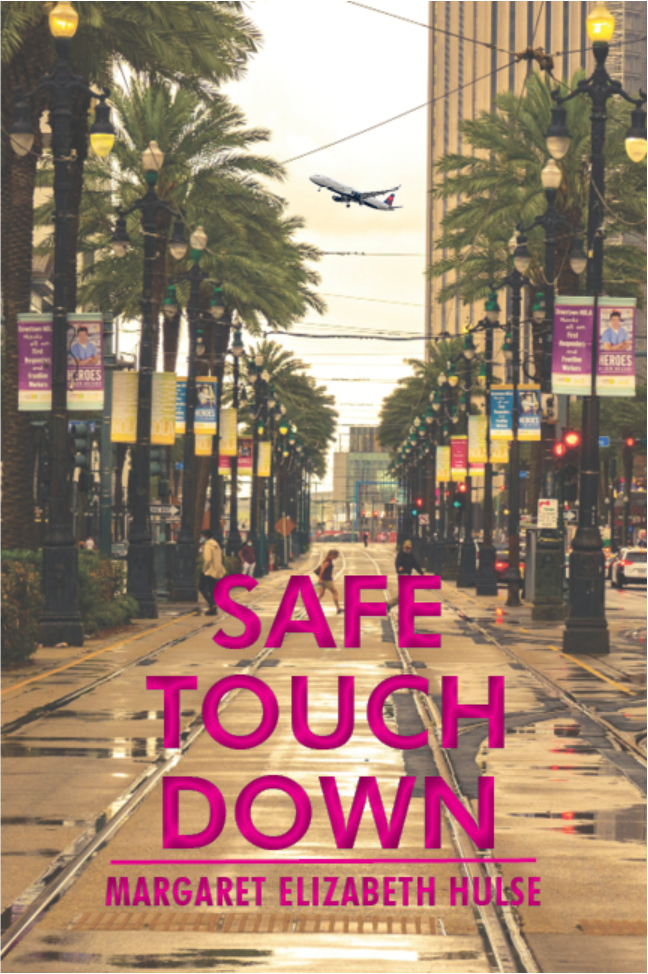
SAFE TOUCH DOWN - A novel
Have you ever had someone come into your life out of nowhere, make an impression so great that it slices through you, holds a mirror to your face, and forces you to step through a reckoning so powerful that you know you'll never be the same?
This is… SAFE TOUCH DOWN
Mona Lamar and Damien St. James - the story
They didn’t end up with a bow-wrapped ending.
No dramatic reunion. No perfect kiss in the rain.
Just two people who collided—not to complete one another, but to awaken something deeper
New Orleans was where their stories first tangled.
The city where her soul was born and his grief began.
It never let either of them go.
Mona, the artist born in New Orleans, sharpened in Dallas, and reborn in the Caribbean, found her voice again.
Damien, who once ran for glory in the league, and ran from pain long before that, found his truth—not in the roar of the crowd, but in the quiet space where healing begins.
She stood on a red-dot stage and told the world how writing saved her life.
He stood in a rec center gym in the Treme and told a room full of boys that being strong doesn’t mean staying silent.
And maybe that’s what love is.
Maybe not forever.
But a mirror. A spark. A reckoning.
A sacred push into becoming.
They may never say it again.
But they’ll never unfeel it.
An excerpt from Chapter 35 - a Revelation
The sun just broke above the horizon and the rooster’s crow offered no mercy. I awoke to a searing pain that ran from the small of my back, down my thigh, and pulsed through my ankle.
My thigh was on fire. I stepped out of bed and stumbled, not out of exaggeration, but because the kick had met my left femur with so much force, no doubt the pain would more than linger.
I looked over at Antoine. He was sleeping soundly and I wanted to hit him even harder.
I stood up and stumbled, palm pressed against the wall to stabilize myself, as I limped to the bathroom to examine my thigh. There was no bruise, but I felt it to my bone.
I massaged my thigh in the shower and couldn't relieve the pain. I sifted through my first aid kit, no Ibuprofen—so I did the next best thing, poured myself a glass of wine and sat at my table and stared out my studio window, and realized that I was really going to have to leave it all behind.
I wasn’t ready. I didn't know if I would ever really be ready.
My quiet, serene studio space. I stood, looking out upon a hidden jungle where the viridian waters of the Caribbean Sea sparkled beneath a cerulean sky. The black Caribbean songbird perched on the fence, sang about this or that. An iguana scrambled across the yard into a pile of fallen leaves from the almond tree.
The pigeons hopped back and forth on the railing of my neighbor's balcony, helping themselves to food and water from their submissive dog's bowl.
I took a long slow sip of wine as the rooster crowed in my neighbor’s yard… the sunlight highlighted the leaves on the plantain trees and the fronds of the coconut palms.
The serenity surpassed the pungent odor from the sargasso and a lump formed in my throat as I breathed in my island home… what was left of the home that I built. My studio that overlooked the sea just beyond the hidden jungle might soon have been nothing more than a memory.
As the day progressed, so did the pain. It shot from my hip down to my ankle, a deep, electric throb that made it nearly impossible to stand up straight. Twice I stumbled trying to walk, I caught myself on the wall just to stay upright. It was early enough to reach the clinic, and I didn’t give myself time to hesitate.
The exam room was sterile and silent—no wifi, no data on my phone—so I let my eyes drift over the faded posters left from the pandemic, reminders to wash your hands and wear a mask. I sat on the edge of the bed and thought about Damien, the somatic work, the breathing, the undoing and re-learning. And how many steps back I’d taken by letting Antoine pull the light out of me again. I pressed a hand to my abdomen and inhaled slowly through my nose, exhaled through my mouth. Again. Again. My shoulders eased, just enough to take the edge off the pain.
I knew the doctor—older, patriarchal, dismissive in that way some men get around women’s pain—but efficient. Practical. A man who treated symptoms, not stories. As I waited, my mind slipped back to my last session with Damien, his voice, his back turned to me, my shadow gathered like a weight in the corner of the room. I breathed through it and watched the second hand crawl across the face of the clock.
I was caught off guard when the door opened and before me stood a doctor I’d never seen before. Handsome. Dark hair, broad shoulders. His glasses framed his kind eyes in a way that made their softness more pronounced. He nodded, smiled, and extended his hand.
“I’m Dr. Mercado.” He glanced at his clipboard. “Mona, what’s going on today? Pain in your leg?”
Something in me buzzed—unexpected, alive. I placed my hand on my thigh. “Right here. It’s a shooting pain, from my spine to my ankle.”
He set his hand gently on my thigh. “What happened?”
I hesitated, stalling, trying to get a read on him. “Where’s Dr. Gamez?”
“Out today,” Dr. Mercado said. “I’m here doing a residency in San Pedro for a few months.”
His accent wasn’t Belizean—nothing British-Caribbean about it. It was softer, musical, warm. Latino, but textured in a way I couldn’t pinpoint.
“Where are you from?”
“Barranquilla… Colombia.” The ‘r’s rolled out of him like a quiet purr.
I nodded. “Doctor… I just want to make sure we have doctor–patient confidentiality.”
His smile warmed, gentle but grounded. “Of course we do.”
Something shifted in me as I hesitated, a mix of embarrassment and vulnerability rising too fast to contain. My throat tightened. Tears gathered. I met his eyes and admitted, through a wash of shame, “My husband kicked me—hard.”
The words sounded absurd once spoken, like they belonged to someone else. Still, I went on, feeling like I needed to explain myself. “He’s a big man. My knee buckled, and I hit the floor pretty hard.”
“I’m so sorry to hear that.” His voice softened as he nodded, placing his hand gently on my thigh. The warmth of his palm, the steadiness of it, disarmed me. And that scent—subtle wood, a trace of sweetness—Dior Homme. Damien wore it, but somehow on Dr. Mercado it felt different. Grounded. Safe.
“Does this hurt?” he asked.
I nodded and breathed through the spike of pain.
“Can you stand up?”
I rose carefully. His touch remained soft as he turned me, guiding me with a respectful certainty. Hands at my hips, then down my leg toward my calf—clinical, but somehow attentive in a way that made my body remember what it felt like to be handled with care instead of force.
“Well,” he assessed, “it could be one of two things. A hairline fracture, or deep tissue bruising. Either way, the treatment is the same—rest. I’ll give you something for the pain and a corticosteroid shot today.”
As he prepped the needle, he asked me to lower the waist of my pants. A flicker of heat rose in my chest. I tugged the waistband down just enough to expose the top curve of my hip. For a second, I wondered if he felt anything—if he registered the intimacy of the moment—or if he’d already tucked it away in that doctor’s compartment I imagined he had.
I assumed the latter. But my mind betrayed me with fantasies of the former.
“All done,” he said gently, after I flinched at the sting. I rolled my pants back up, grounding myself.
“I want to see you again in a few days.” He handed me a prescription, then paused as I reached for the door.
“Mona,” he said, voice steady but weighted. I turned.
“You need to really think about how you’re taking care of yourself.” His expression was quiet, earnest. “When someone hurts you once, it’s extremely likely they’ll do it again.” He held my gaze. “You’re too precious not to take the utmost care of yourself.”
The words landed hard. Because they weren’t just his—they were Damien’s.
And something inside me cracked open at the echo.
I left the clinic overwhelmed and unsettled, my mind echoed with the warmth of Dr. Mercado’s hands and the way his voice slid under my defenses. I didn’t want to be thinking about him—not like that—but something in me had softened in his presence, something that hadn’t softened in a long time.
The steroid took hold as I walked, loosening the tight ache in my leg and gave my stride the illusion of lightness. The seawall grounded me as I meandered along it. The wind rose from the water—cool, salted, alive—and brushed against my skin like a reminder that I belonged on the island. Pelicans skimmed low across the surface, their wings cut shadows across the glittering light. The scent of sargasso and diesel from a passing Lancha blended into the familiar scents of my island life.
A swell of anger moved through me like heat—slow, rising, impossible to ignore. This was my home. My sanctuary. The shimmering turquoise, the rhythm of the tide, the hum of golf carts in the distance, the trade winds whispering soft against my neck. I had carved a life here with my own hands. I didn’t want him poisoning this place for me. Yes, he was born and raised in San Pedro, but I’d made it mine too.
But Dr. Mercado was right—Antoine would hurt me again. The truth settled inside me like the weight I’d been carrying far too long.
My breath hitched as my mind drifted backward, unbidden, to the night his hands first closed around my throat. His fingers weren’t just strong—they were sudden, stunned with fury. They cut off my air while I pierced my nails into his wrists and screamed, hoping for relief. The world narrowed as I screamed through forced breath. All because I texted one of his friends—my own attempt to reach out for help. My vision tunneled, the room tilted, the sound of my own heartbeat pounded inside my skull.
Then another memory rose up. The veranda—humid night air, the first impact: the shock of my shoulder hitting the tiles, the gritty, cold texture scraping my skin. My neighbor pulled him away from me. The police banged on the door. Then the splintering crack as they kicked it open. They searched the house for any illegal substances that would have been his alone, fueling his outrage. Luckily, nothing was found. Still, I told them I didn’t want to press charges.
Another morning—our casita half-packed, cardboard boxes open like unspoken warnings. The dim pre-dawn light filtered through the slats of the blinds. The sting of his palm across my face came before I even registered his movement. A flash of white, then ringing in my ears; the burn spread across my cheek while he muttered something about anxiety and disrespect.
And the storm. The sky, deep blue-grey, the air charged with electricity, the sea rising in violent peaks. The cold needles of rain that sliced into my skin as if the sky itself wanted to peel me open. The boat slammed against the water. I said something about not liking the situation, knowing there was nothing to do but ride it out. Regardless, he grabbed my arm, and I felt the shift in his energy—the way rage coiled through him. He shook my body, as if he thought about throwing me overboard, but instead he threw me down to the hull. The threat wasn’t in his words; it lived in the way he leaned, how easily the sea could swallow me if he decided he was done with me. I felt the edge of the boat beneath my hips and, for a moment, thought—this is it.
And then, the hard knock to my skull as it struck the stone tile because I forgot to buy paper towels—the sound echoed inside my head like something broke. And then—my femur bruised so deep it throbbed with every heartbeat.
It all gathered inside me like a storm cloud, heavy and undeniable.
I looked out at the sea—my sea—and knew a mourning was coming. Not just for San Pedro, but for the version of myself that once believed I could survive it all unchanged.
Later that evening I ducked into the corner store to grab a bottle of wine. I stood in front of the small selection, scanning labels, my leg pulsing with a dull reminder of the day. Behind me came the warm trace of Dior Homme—soft, clean, that same wood-and-sweetness I’d noticed in the clinic—followed by a voice that moved like it had rhythm built into it.
“That Chilean Malbec might take the edge off your leg.”
I turned, and there he was—Dr. Mercado—standing way too close for coincidence. Khaki slacks, Cole Haans, a v-neck scrub shirt, and those glasses that looked like they were custom designed for his face. His eyes held mine just long enough to make my stomach dip, and then he offered a small smile, easy and unforced.
“Hi,” I said, quieter than I meant to. Something fluttered in my chest; maybe because island men didn’t usually look like this—put together without trying, smelling like a cool summer rain on a random Tuesday.
“Did the steroid help?” he asked, voice low, like he didn’t want to take up more space than necessary.
I nodded. “Yes. It did. Thank you.”
He stepped in, not touching me this time, but close enough that I felt his presence move past me. He reached for a bottle on the top shelf, the fabric of his shirt pulled across his back, his movements were smooth, deliberate. Then he set it gently in his basket.
I reached for the Malbec because it felt easier than overthinking.
“Good choice,” he said, and there was something in the way he said it—a blend of warmth and restraint that made me wonder if he noticed the way I was watching him.
“Stay off your leg the best you can,” he added, that subtle doctor authority slipping back in. “I’ll see you in a few days.”
I nodded again, uselessly, while he walked toward the door. He didn’t look back, but the air felt different after he stepped out, like he’d stirred something without meaning to. Or maybe without admitting he meant to.
And for a moment, I just stood there with the bottle of wine in my hand, trying to understand why the memory of his voice—and the quiet way he carried himself, lingered longer than it should have.
Not two days later, I sat at a small local restaurant and tapped away at my laptop while I waited for a bowl of chimole. The place was mostly empty. Nothing more than the hum of the fridge behind the counter, a fan whining overhead, and the steady rhythm of my own typing.
Then the air shifted again.
Dior Homme—warm, clean, familiar. Not overpowering, just enough to make me look up. Dr. Mercado walked in and took a seat at the bar and settled in with the kind of quiet confidence men don’t fake. He wasn’t performing. He wasn’t scanning the room for attention. He was just… present.
I waited a moment before walking over, feeling the fabric of my black shift dress move against my legs. The gold chain lay cool against my collarbone. My red lips were still intact from earlier, and for the first time in days, I felt a little like myself.
When I touched his shoulder, he turned with a soft, immediate smile.
“Mona. Hello.”
Something about the way he said my name—steady, warm, without assumption—hit deeper than it should’ve.
We talked. Easy, light. He listened when I explained that I’d be returning to Dallas to help my dad with my mom. He didn’t rush to give advice, didn’t project some savior complex. He simply nodded, thoughtful, and said, “That sounds like the right decision. Space is important.”
And that landed.
Because Antoine never listened—he reacted. Damien listened, but only through the lens of fixing, pushing, reshaping. Dr. Mercado listened like a man who understood how fragile the body and the mind could be, and how important it was not to inflame what was already hurting.
He asked about my leg and told me to come in the next morning so he could check the progress. Medical. Responsible. Grounded.
Nothing he said felt flirtatious. But nothing shut the door on the idea either. It was the balance—his discipline, his restraint—that made something in me ache with recognition for the kind of safety I hadn’t known in a long time.
I started to walk away when he called after me, “Mona—take down my personal number. You can call me if anything.”
It was a common phrase in Belize, tossed around so casually it usually meant nothing.
But the way he said it?
Measured. Intentional. Not a man throwing out lines to see what stuck. More like a man who meant exactly what he offered—and would never offer it lightly.
I typed his number into my phone. And even though the logical part of me knew it could mean nothing at all… the memory of his voice stayed with me long after I sat back down.
Later that night, I Googled him.
Pathology. Microbiology. Hyperbaric medicine. His credentials stacked up like someone who’d spent his entire life studying the body in exquisite detail. And then there he was on my screen—white coat, stethoscope, glasses framing that calm, deliberate face.
Not a pose. Not a performance. Just a man who looked like he knew exactly who he was.
I closed my laptop and lay back, letting the memory from the clinic drift in. The soft pressure of his thumb as he checked the swelling along my thigh. The way he’d steadied my hips before running his hand down the line of my leg. How he’d crouched beside me, close but never intrusive, his scent settling into the moment like a quiet undertone of clean iris, and warm wood.
To him, it was clinical. Pure anatomy.
But to me, the contrast was sharp enough to taste.
Antoine handled me like I was something to grip, to control. Damien handled me like a puzzle he could solve with discipline and breathwork. But Dr. Mercado… his touch wasn’t claiming or correcting. It was aware. Methodical. Patient. It made me realize how long it had been since anyone touched me without anger or an agenda.
For a second, I let myself wonder if he felt anything at all. If he noticed the shift in my breath. If he sensed the way my body answered that gentleness like it had been starved of it.
The thought unsettled me—in a way that wasn’t unwelcomed.
I knew this feeling. The slide into fantasy. The quickening pulse after a man with a steady presence crosses your path. It happened with Damien too, that first night at the wine bar when he asked questions that made me feel seen. But this was different. Cleaner. Quieter. Deeper underneath the skin.
I was tracing the memory of Dr. Mercado’s voice lightly on my skin when the door banged open.
Antoine stumbled in, beer in hand, eyes glassy—his particular brand of warning shot. My body went rigid on instinct. I braced for the version of him that always followed.
Hours later, after he finally passed out, I poured a glass of wine and slipped into bed. The room was still, but my mind wasn’t. It drifted back to the way the doctor leaned in when I spoke, brow softening because he was actually listening. Not waiting his turn. Not looking for an angle.
Just… listening.
His discipline. His calm. His intelligence. All of it felt like a world of intellect that I had almost forgotten existed.
How desperately I wanted back into it.
I had a taxi drop me off at the clinic the next morning. I’d spent time putting myself together—casual, but deliberate. A fitted workout set, clean sneakers, hair tamed just enough. I wanted to look effortless, but I also wanted to look seen.
My hand hovered over the door handle. One deep inhale, a slow exhale. I reminded myself: just the clinic. Just him doing his job. Nothing else.
He was already there, seated behind his desk. His eyes lifted when I walked in, calm and anchored, not searching for attention but giving presence. He gestured toward a chair in front of his desk.
“Go ahead and have a seat.”
He rose and pulled a chair in front of me, seating himself across from me. Forearms resting lightly on his knees, gaze steady. “How are you feeling?”
“My leg still hurts. The meds help, but I’m only taking them when it really hurts,” I said, trying to sound casual.
He nodded, then asked me to stand.
The second I rose, butterflies tore through my stomach, the same ache I felt when I realized how strongly I felt about Damien. The pull snapped me awake. He placed his hands lightly on my thigh, along the muscle with deliberate care. “Does that hurt?”
It did. But it also made my chest tighten in ways I hadn’t expected. My pulse skittered and heat rose along my spine, because for a fraction of a second, I wanted to lean into it, to feel the grounded weight of him against me.
“It still hurts,” I said, voice catching.
He nodded and returned to the clinical assessment. Deep tissue bruise. Rest. Recovery. Clear, precise, professional.
And then he leaned in slightly, voice low, eyes sharp but soft. “Mona, are you feeling safe at home?”
Something in me broke open. Years of fear, anger, exhaustion—everything I had tried to lock away—spilled out. I choked back tears, my throat tightened. I told him everything: sleepless nights, one eye open; the rage I’d lived under; the returning to Dallas, the fear, the grief over leaving the island, not on my terms, but on those of an aggressive narcissist.
He didn’t flinch. He didn’t interrupt. His gaze softened, lips pressed just enough together to indicate concern. He nodded with each word, steady, deliberate.
And my chest tightened even more because I realized—because through his attentiveness, through his steadiness, I felt like I was falling for him deeper and deeper with every nod, every purse of his lips.
I couldn’t stop myself. Words tumbled out, awkward, shaky, urgent.
“Doctor…”
“Yes, Mona?”
“I—I have to say something, and I’m… embarrassed, and I feel ridiculous…” My fingers tapped nervously against the desk. I looked up, swallowed hard. “I’m attracted to you. I’ve been thinking about you since the first day. I know this probably happens to you all the time. But I… I needed to say it.”
He didn’t flinch. He just nodded. “Yes, it happens. I understand.”
The words left me hollow and exposed, raw to my very core. My chest ached. My breath was shallow, but my body was alive because I had laid myself bare. My blue eyes, glassy with tears.
“Mona, you know that I cannot be anything more than your doctor. I could jeopardize my credibility.”
“I know, and I’m so sorry,” I whispered. “I shouldn’t have… I just—” My words caught in my throat, tangled in something that I didn’t understand in that exact moment.
“You did nothing wrong,” he said softly, steady. “You’re vulnerable. Overwhelmed. You’re allowed to feel and express that.”
I heard him, and I paused. “But…” Through tears and shaky breath, I had a revelation. Still raw, still feeling the ache of rejection, a truth washed over me.
“Doctor Mercado. I believe that everything happens for a reason.” He nodded and I continued. “Since I met you, something in me has been unlocked. It’s been a long time since I’ve been around someone who is emotionally intellectual, unwaveringly compassionate, and dedicated to higher learning and achievement. You make me realize how starved I’ve been of people like you.”
He smiled—softly—and in that moment I actually heard my own words. They landed in me like a truth I’d been avoiding. I realized that if I never stepped onto that red-dot stage and gave my TED talk, I would carry that regret for the rest of my life. I saw, with a sudden sharpness, that the complacency I’d been living in wasn’t my nature at all. It was a cage I’d been conditioned into—fear, disappointment, other people’s limitations pressed onto me until I started mistaking them for my own. I had dreams. I had vision. And somewhere along the way, like crabs on a bucket, I let people pull me down to a place I never belonged.
The room contracted around me. I wanted to collapse into him, wanted to dissolve into the warmth of him—but I also felt the clarity of his restraint. There was no claim, no ownership, just the steadiness I’d been starving for.
When our session drew to a close, we rose together. His arms wrapped around me and I pressed my own against him, heart hammering, breath short. His subtle wood-and-iris scent curled around me, tugging at something deep inside.
And then his hands cupped my face. Slowly. Deliberately. I could feel the pulse of life there, not ownership, not lust—just… recognition. He leaned in, and our lips met and parted with intention. The kiss was brief but infinite, a benediction, a permission slip to remember who I was, to remember the power I’d buried beneath pain and fear. A clean, deliberate breath of what I deserved, as if he was saying, I’m setting the bar for you, don’t drop below it.
I pressed my forehead to his chest, and let the heat of my body mingle with the calm of his. His hand traced the line of my back once, lightly, and we stepped apart.
“Thank you,” I whispered, voice ragged.
“You’re welcome. Now go. Take care of yourself.”
And I did. But this time, I carried something more than safety. I carried the fire that had always been inside me—the courage, the clarity, the recognition that I had everything I needed to stand on my own, to speak my truth, to step onto the TED stage and finally claim my voice.